
View Our Recent Work:

A seacock is a through-hull valve that controls water flow between your vessel and the sea, and a failed one can sink your boat faster than almost any other mechanical failure. Yacht seacock maintenance explained properly means understanding inspection schedules, lubrication techniques, material vulnerabilities, and the warning signs that demand immediate action. These fittings serve engines, toilets, bilge pumps, and raw water cooling systems. They are the last line of defense between your hull and open water. Neglect them, and the consequences are not just expensive. They are catastrophic.
What is yacht seacock maintenance and why does it matter?
Seacock maintenance is the regular practice of inspecting, exercising, lubricating, and replacing the valves and hoses that pass through your hull. The industry term for the fitting itself is a “through-hull valve” or “seacock,” and both terms are used interchangeably by marine surveyors and boatyards. Most yachts carry between four and twelve of these fittings, covering everything from engine cooling intakes to cockpit drains.
Bronze and composite materials are the two most common choices for modern seacocks. Bronze offers proven durability and a long service history in salt water. Composite models, often made from glass-reinforced nylon, resist galvanic corrosion but can become brittle over time. Both types require active care regardless of what the manufacturer claims.
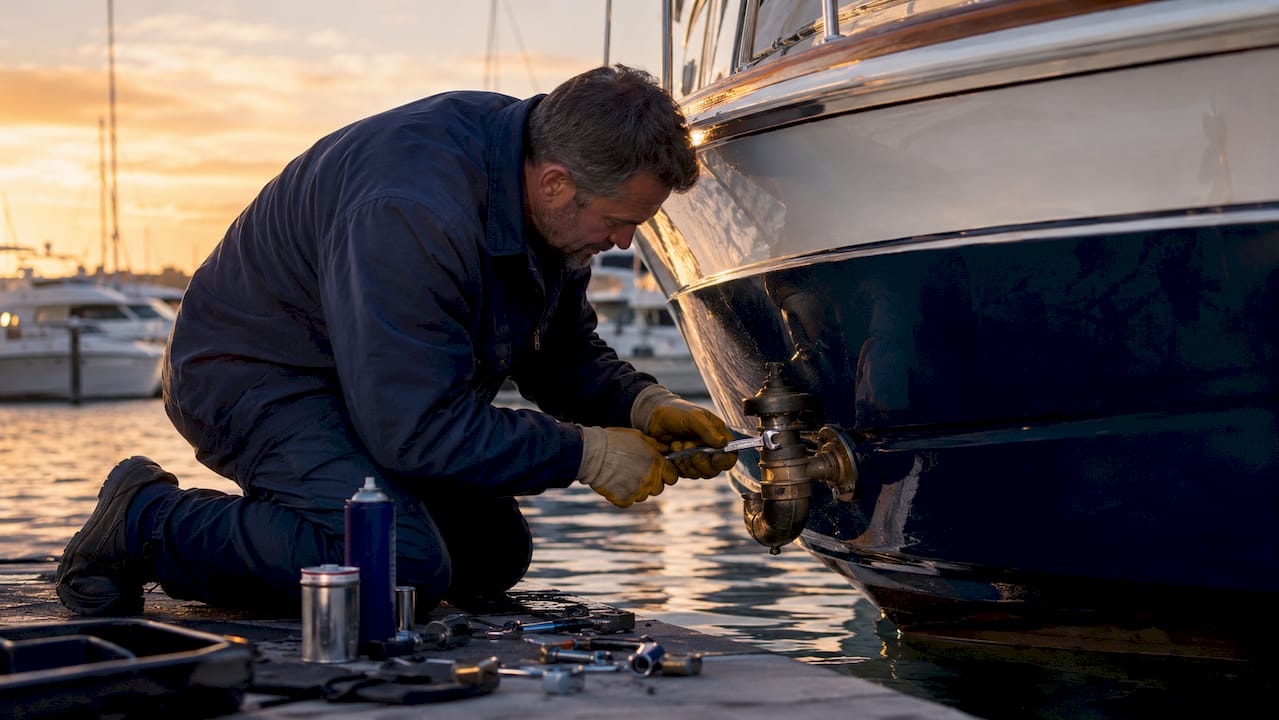
The stakes are straightforward. A seized seacock cannot be closed in an emergency. 40% to 50% of seacocks on inspected vessels are seized and unable to operate, with another 25% difficult to reach. That statistic, from marine surveyor Nigel Calder, means roughly half the boats on the water right now carry a valve that will not close when it needs to.
What is the recommended maintenance schedule for seacocks?
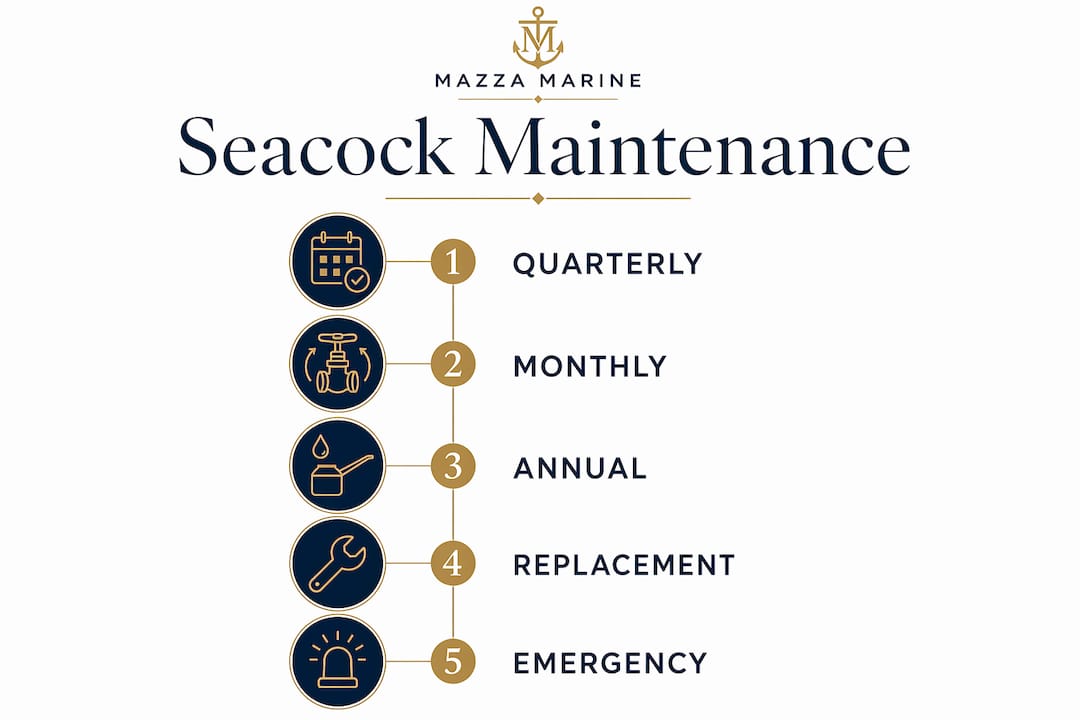
Industry best practice mandates a three-tier schedule: quarterly visual inspections, monthly valve exercising, and annual lubrication. Each tier serves a distinct purpose, and skipping any one of them compounds the risk of the others.
Quarterly visual inspection
- Check each seacock for visible corrosion, pitting, or white powdery deposits on bronze fittings.
- Inspect the hose connections for cracking, softness, or discoloration. A hose that feels spongy or shows surface cracks needs replacement before it fails.
- Confirm the valve handle moves freely through its full range of motion without grinding or stiffness.
- Verify that each seacock is clearly labeled and accessible. A fitting buried behind a panel or under a bunk is a liability, not an asset.
- Check that the backing plate beneath each fitting is solid and shows no signs of delamination or rot.
Monthly valve exercising
Turn every seacock from fully open to fully closed and back again at least once per month. Regular exercising preserves valve function and prevents seizing in place. This takes less than five minutes for an entire boat and costs nothing. Think of it as the simplest insurance policy in your yacht maintenance checklist.
Annual lubrication and deep service
Annual lubrication is the most thorough step in the cycle. Annual haul-out provides the best opportunity to fully disassemble, inspect, and service seacocks with minimal risk to hoses and fittings. Working out of the water eliminates the risk of flooding during disassembly.
Pro Tip: Disconnect hoses carefully during annual service. If a hose resists removal and shows any brittleness, replace it rather than force it. A cracked hose during reassembly is a slow leak waiting to happen.
How do material types affect seacock longevity?
The material your seacock is made from determines how it ages and what kind of attention it needs. Bronze, brass, and composite fittings each respond differently to salt water, temperature swings, and electrical exposure.
- Bronze: The most trusted material for through-hull fittings. A thin greenish patina on bronze is normal and protective. Aggressive cleaning can cause dezincification, stripping zinc from the alloy and leaving a porous, weakened structure that looks fine until it crumbles.
- Brass: Often confused with bronze but significantly less durable in salt water. Brass dezincifies faster and is not approved by the American Boat and Yacht Council (ABYC) for below-waterline use. If your boat has brass seacocks, replacement is the right call.
- Composite/Nylon: Resistant to galvanic corrosion but susceptible to UV degradation and impact damage. Composite fittings can become brittle after years of thermal cycling.
“Maintenance-free” labels are marketing. All seacock types are prone to fouling if left static, regardless of material or manufacturer claims.
Galvanic corrosion is a specific threat for metal fittings. When two dissimilar metals sit in salt water and share an electrical path, the less noble metal corrodes rapidly. Corrosion inhibitors and bonding systems protect metal seacocks by minimizing galvanic corrosion risks. Zinc anodes placed near through-hulls sacrifice themselves to protect the more valuable bronze fittings. Check and replace anodes at every haul-out.
Water salinity, temperature, and nutrient levels all affect fouling rates. Warmer, nutrient-rich waters like those found in South Florida accelerate barnacle growth and corrosion on exposed fittings. Boats kept in Florida marinas need more frequent inspection than those kept in cooler northern climates. Mazzamarine’s Miami maintenance schedule addresses exactly this kind of climate-driven wear.
What are common seacock problems and how do you fix them?
The most common problem is a seized valve. A seacock that will not turn is not just inconvenient. It is a safety emergency waiting for the wrong moment.
| Problem | Likely Cause | Solution |
|---|---|---|
| Valve will not turn | Corrosion or lack of exercise | Apply penetrating oil, work gently, then lubricate with lithium grease |
| Weeping around the body | Worn packing or cracked housing | Tighten packing nut first; replace fitting if housing is cracked |
| Hose softness or cracking | Age and heat exposure | Replace hose immediately; do not reuse brittle hoses |
| White powdery deposits on bronze | Dezincification | Test material hardness; replace if metal is soft or crumbly |
| Valve handle spins freely | Internal ball or plug failure | Replace the seacock; do not attempt to repair a failed ball valve |
Proactive cleaning and lithium grease often return frozen valves to service for far less than the cost of replacement. Patience matters here. Apply penetrating oil, wait 24 hours, and work the handle gently in small increments. Forcing a seized valve risks cracking the body at the hull.
Hose quality is as critical as the seacock itself. Replacing aged hoses during maintenance significantly reduces leak risk. Use only ABYC-compliant, double-clamped hose with stainless steel clamps. Never use a single clamp below the waterline.
Pro Tip: Keep a tapered softwood bung tied directly to each seacock with a short length of line. Softwood bungs enable immediate emergency sealing if a fitting fails unexpectedly. Hammer one in and you buy time to get to a boatyard.
What tools and steps make seacock maintenance effective?
Thorough seacock care follows a clear sequence. Skipping steps, especially hose removal, leaves the internal valve surfaces unlubricated and vulnerable.
- Close the seacock fully before beginning any work. Confirm it is seated.
- Remove the hose by loosening both hose clamps and twisting gently. True maintenance requires hose removal to access internal valve parts. If the hose is brittle or cracks during removal, replace it before reassembly.
- Clean the valve body with a mild marine cleaner and a soft brush. Avoid abrasive pads on bronze. Never use chemical drain cleaners containing lye or sulfuric acid. These chemicals dissolve bronze and brass components internally, drastically shortening seacock lifespan.
- Apply marine-grade lithium grease to the valve plug or ball, the stem, and the packing area. Work the handle through its full range several times to distribute the lubricant evenly.
- Inspect the backing plate and hull laminate around the fitting for softness or delamination. Any soft spot in the surrounding fiberglass warrants a marine surveyor’s opinion before you splash.
- Reassemble with new hose clamps if the existing ones show rust or corrosion. Tighten firmly but do not overtighten. Overtightening crushes the hose and creates a failure point.
- Open the seacock slowly after reassembly and check for any weeping at the body or hose connection.
- Log the service date in your maintenance record. A written log is your best defense in an insurance claim and your best reminder for the next service interval.
Recommended products for this process include West Marine lithium grease, CorrosionX for metal protection, and Forespar or Groco seacocks for replacement. Work out of the water whenever possible. The haul-out process is the safest environment for any below-waterline service.
Pro Tip: Label every seacock with a waterproof tag showing its function, the date of last service, and the hose size. New crew members and emergency responders will thank you.
Key takeaways
Seacock maintenance is the single most safety-critical item on any yacht plumbing maintenance checklist, requiring quarterly inspection, monthly exercising, and annual lubrication to prevent seizure and flooding.
| Point | Details |
|---|---|
| Exercise valves monthly | Turn every seacock fully open and closed once per month to prevent seizing. |
| Annual haul-out service | Disassemble, clean, and lubricate seacocks with lithium grease during each haul-out. |
| Replace brittle hoses | Never reuse cracked or soft hoses; replace with ABYC-compliant, double-clamped hose. |
| Know your material | Bronze patina is protective; brass below the waterline should be replaced with bronze or composite. |
| Keep emergency bungs ready | Tie a softwood bung to each seacock so any crew member can seal a failed fitting immediately. |
What I’ve learned after years of watching seacocks fail
The most common mistake I see boat owners make is treating seacocks like furniture. They are there, they work, so nobody touches them. Then a surveyor finds half of them seized solid and the owner is genuinely surprised.
The second most common mistake is using a seacock as a footrest. Excessive torque or foot pressure can cause damage not visible until catastrophic failure occurs under pressure. I have seen beautiful bronze fittings with hairline stress fractures that looked perfectly fine until the boat was back in the water. The fitting let go at the dock, fortunately. It does not always happen at the dock.
What actually works is boring consistency. A five-minute monthly exercise routine and a proper annual service during haul-out will keep most seacocks in reliable condition for decades. The superyacht world is moving toward condition-based monitoring using vibration and thermal data to predict valve failure before it occurs. For the rest of us, a good flashlight, a tube of lithium grease, and a written log accomplish the same goal at a fraction of the cost.
The peace of mind from a well-maintained seacock system is real. You sleep better at anchor when you know every valve on your boat will close on command.
— Jason
Mazzamarine’s approach to professional seacock care
Seacock service is one of those jobs that rewards professional hands, especially when hoses are aged, fittings are corroded, or access is tight. Mazzamarine’s network of Florida yacht experts handles the full scope of through-hull maintenance, from annual inspection and lubrication to emergency hose replacement and fitting upgrades.
If your last seacock service was more than a year ago, or if you have never had one done at all, a professional inspection is the right next step. Mazzamarine’s complete maintenance packages cover seacock care as part of a thorough annual service, saving you time and protecting your investment. For boats showing signs of corrosion or hose wear, the yacht plumbing repair guide for Florida owners walks through exactly what a professional service involves. Reach out to Mino, Luigi, and the Mazzamarine team to schedule your next haul-out service.
FAQ
What is a seacock on a yacht?
A seacock is a through-hull valve that controls water flow between the sea and onboard systems like engines, toilets, and bilge pumps. It is the primary shutoff point for any fitting that passes through the hull below the waterline.
How often should yacht seacocks be serviced?
Industry best practice calls for quarterly visual inspections, monthly valve exercising, and annual lubrication with marine-grade grease. Annual service is best performed during haul-out when the boat is out of the water.
Why do seacocks seize up?
Seacocks seize when the valve plug or ball corrodes or accumulates marine growth from sitting static for extended periods. Regular monthly exercising prevents this and is the single most effective seacock care tip available.
Can I use any grease on a seacock?
Use only marine-grade lithium grease or a product specifically rated for submerged metal fittings. Never use petroleum-based greases that can swell rubber components or degrade composite materials.
When should a seacock be replaced rather than serviced?
Replace a seacock when the housing shows cracks, the internal ball or plug has failed, the material is soft from dezincification, or the fitting is made of brass below the waterline. Repair is not a safe option for a structurally compromised through-hull fitting.
Recommended
Text or Call 954-330-9653 Schedule Appointment
Mazza Marine Yacht Services & Refit

Fiberglass Upgrades and Damage Repair

Premium Yacht Paint/ Faux Teak

Fishing: Custom Rods, Reels,Tackle

Electrical, Electronics and Navigation

Paint, Hull and Gelcoat

Teak Decks, Wood Cabinets, Carpentry

Canvas, Enclosures and Upholstery

Mechanical, Repower and Running Gear

Plumbing, Bilge and Thru-Hulls

Welding and Custom Fabrication

Interior Refit And Past Work
Get your yacht value Estimate
"*" indicates required fields