
View Our Recent Work:

You’re running south along the Intracoastal at 2,800 RPM when you feel it: a low, rhythmic shudder working up through the helm. It wasn’t there last month. Now it’s impossible to ignore, and somewhere in the back of your mind, you’re calculating repair costs. Yacht vibration troubleshooting is one of the most misunderstood areas of ownership, yet one of the most consequential. Catch the right cause early and you’re looking at a prop repair or a set of engine mounts. Miss it, and that shudder becomes a bent shaft, a failed bearing, or worse.
Table of Contents
- Understanding yacht vibration: causes and patterns
- Preparing for troubleshooting: tools, observations, and data gathering
- Step-by-step yacht vibration troubleshooting process
- Avoiding common mistakes and recognizing when to call professionals
- Maintaining smooth operation: best practices to prevent future vibration
- Why chasing comfort over measurement can undermine your yacht’s health
- Get expert help for vibration issues with Mazza Marine’s Florida yacht services
- Frequently asked questions
Key Takeaways
| Point | Details |
|---|---|
| Identify vibration patterns | Observe when and how vibration occurs to target the correct mechanical cause effectively. |
| Inspect props and shafts | Check for bent blades, debris, or shaft bends as they are common and fixable vibration sources. |
| Engine mounts matter | Worn or damaged mounts transmit engine vibration and must be replaced to reduce shaking. |
| Avoid comfort tuning traps | Masking vibration without measuring can worsen mechanical damage over time. |
| Know when to call pros | Use professional diagnostics for complex shaft and bearing checks or unresolved issues. |
Understanding yacht vibration: causes and patterns
Before you touch a wrench, you need to read what the boat is telling you. Vibration is not random noise. It follows patterns, and those patterns point directly toward specific mechanical problems.
Higher-speed vibration most commonly traces back to a damaged or unbalanced propeller, with vibration behavior varying predictably based on speed and RPM. That is your starting framework for any boat vibration diagnosis. Two behaviors tell the story quickly:
- Vibration that grows with boat speed in gear points toward the propeller, drive shaft, or shaft bearings. The faster you go, the more the imbalance amplifies.
- Vibration that changes with engine RPM even when the transmission is in neutral suggests engine mounts or engine alignment issues, not the rotating drive system.
Beyond those two patterns, common causes of yacht vibration issues include:
- Damaged, bent, or fouled propeller blades
- A bent or out-of-round drive shaft (shaft runout)
- Worn or deteriorated shaft bearings, particularly the stern tube bearing
- Degraded engine mounts that have lost their ability to isolate vibration
- Cavitation, which occurs when air or vapor bubbles collapse near the propeller and produces a rough, irregular vibration at higher RPMs
- Fishing line or debris wrapped around the shaft, an especially frequent issue for Florida boaters in seagrass-heavy waters
Understanding which RPM range and which conditions trigger vibration narrows your search considerably before you ever leave the dock. Pair that with good boat engine troubleshooting habits, and you are already ahead of the problem.
Preparing for troubleshooting: tools, observations, and data gathering
Effective yacht stability troubleshooting starts on paper, not in the bilge. Before any hands-on inspection, gather data and prepare your tools. A rushed, unstructured approach wastes time and leads to misdiagnosis.
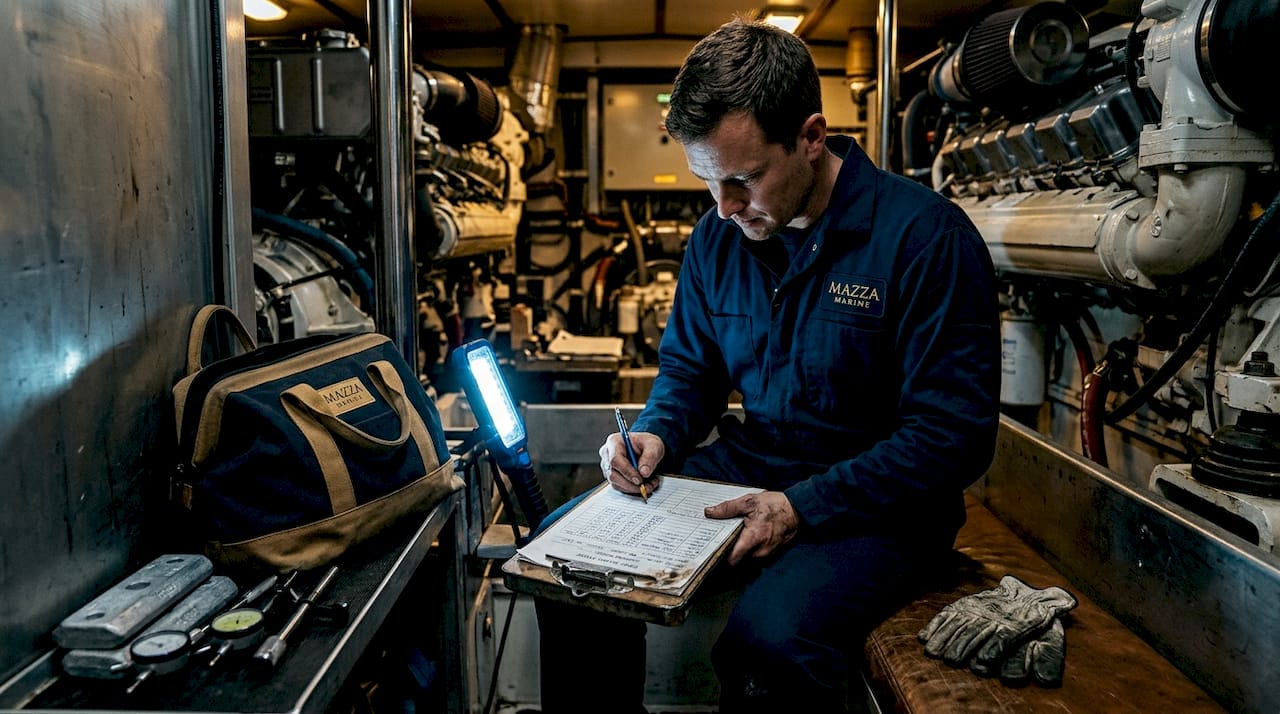
Recording the exact speed or RPM range where vibration occurs, along with whether it changes with trim or load, is what separates a focused diagnosis from hours of guesswork.
Essential tools and observations checklist:
- Notebook or notes app to log RPM, speed, throttle position, and vibration intensity
- Flashlight and inspection mirror for prop and shaft visual checks
- Torque wrench for engine mount bolt inspection
- Dive mask or underwater camera for in-water prop inspection
- A trusted crew member to report vibration feel from different positions on the boat
Pre-sea-trial observations to capture:
| Item to observe | What to record |
|---|---|
| RPM range when vibration starts | Exact RPM at onset and peak |
| In gear vs. neutral vibration | Whether vibration occurs out of gear |
| Speed versus RPM correlation | Does it track with boat speed or engine speed? |
| Trim angle effect | Does vibration change when trim tabs are adjusted? |
| Load conditions | Does vibration worsen with full tanks or passengers? |
| Vibration location | Felt more at helm, midship, or stern? |
Trim is a detail many owners overlook. On Florida sportfish yachts, running tab-heavy to plane early can mask or exaggerate vibration symptoms. Note your exact trim angle during each trial pass. Your yacht heavy machinery maintenance guide and a solid understanding of marine mechanical systems will further support your preparation.
Step-by-step yacht vibration troubleshooting process
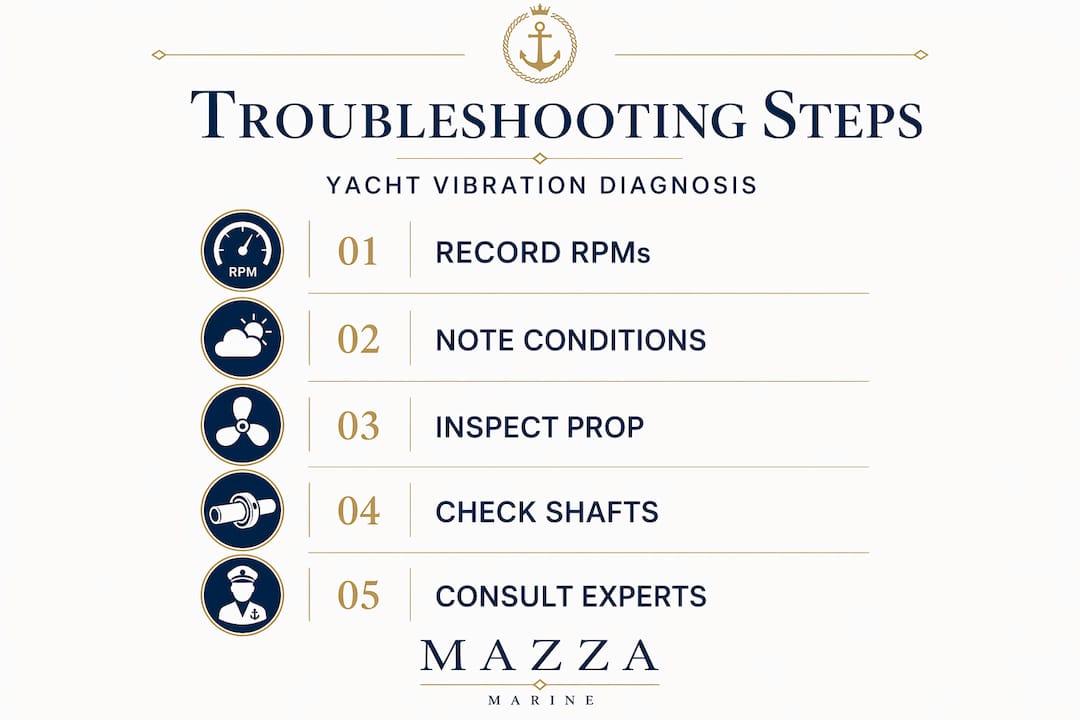
Now that you’re prepared, let’s get hands-on. Follow this sequence carefully. Order matters because each step either confirms or rules out a cause before moving to the next.
-
Conduct a structured sea trial. Run the boat through RPM bands from idle to wide-open throttle in calm water. Log exactly where vibration begins, peaks, and subsides. Also run the engine in neutral at various RPMs to isolate engine-side causes.
-
Inspect the propeller visually. Prop-related issues cause 60 to 70% of vibration complaints, and bent blades as small as 2 to 3 mm create noticeable vibration above 2,500 RPM. Check each blade for dings, cupping, nicks, and fouling. Rotate the prop by hand and watch for wobble at the hub. Blade deviation greater than 1.5 mm warrants professional prop balancing or replacement.
-
Remove debris from the shaft. Before any further inspection, check for fishing line, seagrass, or net wrapped around the shaft. A single wrap of monofilament can cause sudden, severe vibration and mask other symptoms. This is especially relevant for Florida waters where seagrass entanglement is common.
-
Check shaft straightness. A bent shaft is a major source of vibration and is often caused by a prop strike. You can do a preliminary check by rotating the shaft slowly and watching for runout (wobble) at multiple points. Any detectable bend requires a professional haul-out for accurate measurement and correction.
-
Inspect the shaft bearings. With the boat hauled or with access through the bilge, check the stern tube bearing for play, scoring, or wear. Grab the shaft and try to move it radially. Any movement beyond manufacturer spec means the bearing needs replacement. Worn bearings allow shaft wobble that multiplies wear on every connected component.
-
Inspect engine mounts. Examine each mount for cracks in the rubber, oil saturation, and collapse. A saturated or cracked mount no longer isolates vibration and allows the engine to move under load, misaligning the shaft dynamically. Replacing mounts is one of the most effective yacht engine vibration solutions available and is often overlooked until failure is obvious.
-
Verify shaft alignment. Alignment work only means something after prop condition, shaft straightness, and bearing condition are confirmed. Checking alignment on a bent shaft gives you a false reading every time. Use a dial indicator or rely on a qualified technician for this step. Good engine maintenance tips will walk you through what to expect from this process.
-
Repeat the sea trial. After each repair or adjustment, run the same RPM band test and compare notes to your baseline log. Vibration reduction should be measurable, not just felt.
Pro Tip: During sea trials, assign someone to press their palm flat against the helm dash, the sole, and the transom while you hold each RPM band for 30 seconds. Vibration location changes between those points help pinpoint whether the source is forward of the engine or aft of it.
Symptom-to-cause quick reference:
| Symptom | Most likely cause | First check |
|---|---|---|
| Vibration only in gear, increases with speed | Propeller or shaft imbalance | Prop visual inspection |
| Vibration at specific RPM in or out of gear | Engine mount failure | Mount inspection |
| Sudden vibration after offshore run | Debris on shaft | Shaft visual check |
| Rumbling felt at stern only | Stern tube bearing wear | Bearing play check |
| Vibration across all RPMs | Multiple causes or shaft bend | Full sequence inspection |
Avoiding common mistakes and recognizing when to call professionals
While many fixes are doable yourself, knowing the limits and avoiding common diagnostic errors protects your yacht from further damage.
Common mistakes that cost owners time and money:
- Treating vibration as a comfort issue. Reducing boat vibrations by adding insulation or repositioning gear masks the symptom without addressing mechanical stress. You feel better; the drivetrain does not.
- Checking alignment before fixing the prop and bearings. Alignment readings on a compromised drivetrain are meaningless. You will keep chasing a number that moves every time conditions change.
- Waiting to see if it gets worse. Strong or increasing vibration risks progressing damage to the shaft, bearings, stern tube, and hull, demanding prompt inspection. A week of denial can turn a prop repair into a full shaft replacement.
“The most expensive repairs we see aren’t caused by accidents. They’re caused by ignored vibrations that were attributed to ‘how the boat runs.’”
Specialized measurement equipment is required for shaft straightness, bearing analysis, and engine alignment. If your initial checks come back inconclusive, that is your cue to bring in a professional, not a reason to keep guessing.
Call a professional when:
- Vibration source is unidentified after the full checklist
- You suspect a bent shaft or need precise shaft runout measurement
- Engine alignment requires dial indicator verification
- Vibration is increasing between trips despite no obvious cause
Pro Tip: When you contact a service center, bring your vibration log with RPM ranges, trim angles, and conditions noted. Technicians can start diagnostics in hours instead of days when the symptom history is clear. Know the signs you need yacht repairs before the problem escalates.
Maintaining smooth operation: best practices to prevent future vibration
After addressing current vibration, proactive maintenance is what keeps it from returning. Florida’s warm saltwater environment accelerates corrosion, biofouling, and rubber degradation faster than most other cruising grounds. Your maintenance rhythm needs to match that reality.
Ongoing prevention practices:
- Inspect props for blade damage, edge wear, and marine growth after every extended trip or haul-out
- Check engine mounts annually for rubber condition, oil exposure, and compression collapse
- Schedule shaft alignment verification at each haul-out and after any prop strike, grounding, or hard impact
- Monitor for cavitation patterns during normal operation, as persistent cavitation erodes blade edges and triggers imbalance over time
- Avoid adjusting trim tabs or engine settings to smooth out vibration without first understanding its cause
Yachts operating with flexible foundations and variable loads experience shaft alignment shifts that dockside checks alone cannot capture. Thermal growth as the engine warms up, hull flex underway, and shifting fuel loads all affect alignment dynamically. Measuring under real operating conditions gives you a far more accurate picture than static checks at the dock.
Pro Tip: Keep a simple vibration log on your phone. After each run, note any new sensations, the RPM at which they occur, and whether conditions were calm or rough. Trending that data over two or three months reveals patterns long before they become failures. Pair this habit with routine marine mechanical system maintenance for a complete picture.
Why chasing comfort over measurement can undermine your yacht’s health
Here is something most vibration articles won’t tell you directly: the smoothest-feeling fix is often the most dangerous one.
Comfort tuning frequently masks symptoms while increasing hidden mechanical stress, accelerating bearing wear, damaging couplings, and causing seal failures. The boat feels better at the helm. The drivetrain wears faster below the waterline. That trade-off only becomes visible when a bearing seizes or a shaft coupling fails offshore.
“They were not tuned out. They were redirected.”
That is the cautionary truth about vibration masking. The energy does not disappear. It transfers to the path of least resistance, which is usually the most expensive component to replace.
Professional marine engineers who do this work well do not prioritize feel. They use dial indicators, vibration analysis equipment, and thermal imaging to confirm that what is smoother also measures as healthier. Subjective smoothness and mechanical integrity are not the same thing, and conflating them is one of the most common errors we see in the field.
The mindset shift that protects your investment is simple: quiet does not mean fixed. Measurably reduced vibration, confirmed through repeatable sea trial data and instrument readings, means fixed. Demand that standard from your service providers, and from yourself when you are doing preliminary checks. Your engine maintenance impact on vibration is a direct reflection of how rigorously you apply this principle over time.
Get expert help for vibration issues with Mazza Marine’s Florida yacht services
Understanding the troubleshooting process is genuinely empowering. But when vibration persists after your initial checks, professional expertise delivers the precision and accountability that lasting repairs require.

At Mazza Marine, we bring a dedicated network of Florida yacht experts to every vibration diagnosis. From propeller and shaft inspections to engine mount replacement, shaft alignment verification, and full drivetrain repairs, we cover the complete mechanical picture. Brothers Mino and Luigi built Mazza Marine on a passion for the sea and a commitment to relationships that last beyond a single repair. Whether you need a targeted fix or a complete mechanical refit, knowing the signs you need yacht repairs early keeps your costs predictable and your time on the water uninterrupted. Explore our boat engine troubleshooting guide or learn how mechanical refit upgrades can extend your yacht’s performance and lifespan. Contact Mazza Marine and let’s keep your boat running the way it was built to.
Frequently asked questions
What are the most common causes of yacht vibration?
Most yacht vibrations trace back to damaged or unbalanced propellers, bent shafts, worn bearings, and deteriorated engine mounts affecting the drivetrain and hull.
How can I tell if vibration is caused by the propeller or engine mounts?
If vibration increases with boat speed while in gear, propeller or shaft issues are likely; if it changes with engine RPM even out of gear, engine mounts or alignment are the more probable cause.
When should I call a professional for vibration problems?
If vibration persists after your initial checks, or specialized shaft and alignment measurements are needed, schedule professional diagnostics rather than continuing to troubleshoot by feel.
Is it safe to keep operating a yacht with mild vibration?
Mild vibration may be tolerable short-term, but strong or increasing vibration risks damage to the shaft, bearings, stern tube, and hull, making prompt inspection necessary.
What maintenance helps prevent yacht vibration?
Ongoing measurement and maintenance of propellers, engine mounts, and shaft alignment, combined with consistent vibration trend logging, keeps most common vibration causes from developing into serious failures.
Recommended
Text or Call 954-330-9653 Schedule Appointment
Mazza Marine Yacht Services & Refit

Fiberglass Upgrades and Damage Repair

Premium Yacht Paint/ Faux Teak

Fishing: Custom Rods, Reels,Tackle

Electrical, Electronics and Navigation

Paint, Hull and Gelcoat

Teak Decks, Wood Cabinets, Carpentry

Canvas, Enclosures and Upholstery

Mechanical, Repower and Running Gear

Plumbing, Bilge and Thru-Hulls

Welding and Custom Fabrication

Interior Refit And Past Work
Get your yacht value Estimate
"*" indicates required fields