
View Our Recent Work:

A yacht watch schedule is a formal, recurring rotation that assigns crew members to timed duty shifts, ensuring the vessel is monitored continuously around the clock while every person gets adequate rest. The industry term for this practice is watchkeeping, and it sits at the heart of safe offshore sailing. Common watch configurations include the 4-on/4-off, 3-on/6-off, and 4-on/8-off systems, each designed to balance safety with crew endurance. Whether you are planning your first bluewater passage or refining how your crew operates on longer Florida runs, understanding the watch schedule for sailing is the single most important operational decision you will make before leaving the dock.
What is a yacht watch schedule and why does it matter?
A yacht watch schedule is the backbone of safe offshore passage making. Without one, crew fatigue accumulates fast, situational awareness drops, and the risk of collision or grounding climbs sharply. The schedule defines who is responsible for the helm, navigation, and lookout duties at every hour of the day and night.
The core purpose is simple: no vessel should ever be left unattended at sea. A well-designed yacht crew watch rotation guarantees that a qualified person is always on deck, alert, and accountable. It also protects the rest of the crew by building predictable sleep windows into the daily rhythm.

Watch schedules also set the social tempo of a voyage. Meal times, maintenance windows, and even morale all flow from how the watches are structured. Get the rotation right and the crew functions like a well-tuned engine. Get it wrong and even a short passage can feel punishing.
Common watch systems and how they work
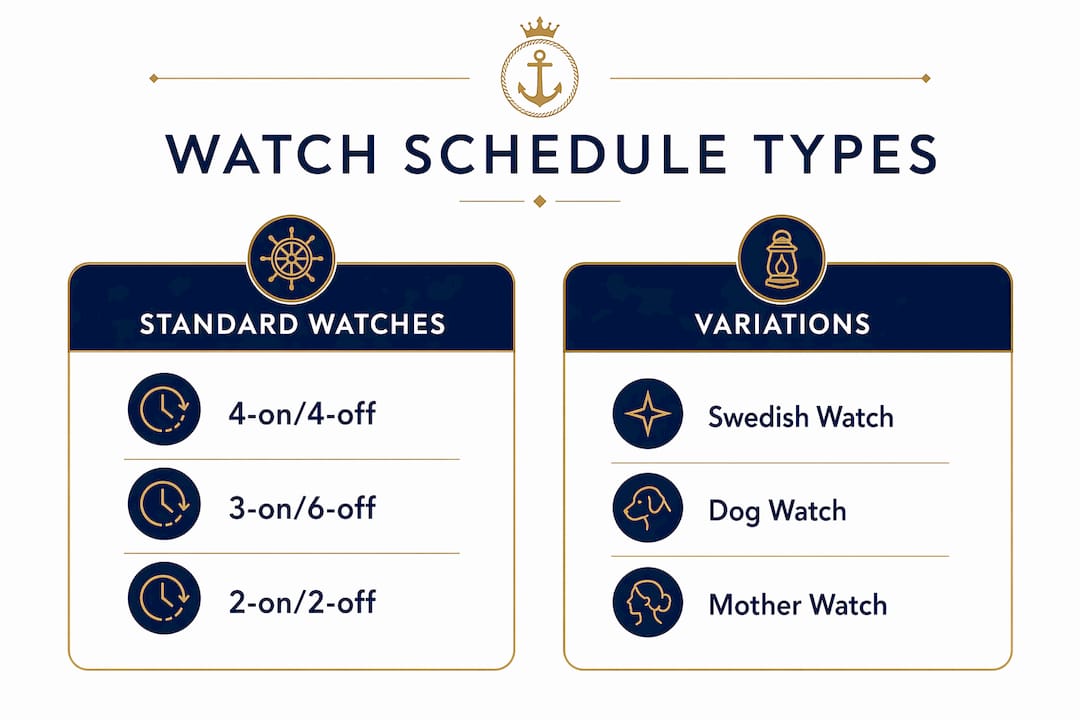
Watch systems vary widely, but three configurations dominate offshore sailing. Each has a distinct rhythm and suits different crew sizes and passage lengths.
The three core systems
- 4-on/4-off. The most widely used model. One watch group takes the helm for four hours, then rests for four hours while the other group takes over. It is simple to explain and easy to enforce. The downside is that sleep deprivation risk rises in rough weather, when rest periods rarely deliver genuine sleep.
- 3-on/6-off. Three hours on, six hours off. This system gives crew longer rest windows and is popular on passages with three or more watch-capable crew. The shorter active watch keeps alertness high.
- 4-on/8-off. Often called the merchant style. Requires at least three watch groups to function. It delivers the best rest of the three systems and suits larger yachts with more crew.
Swedish watch and dog watch variations
The Swedish watch system staggers watch lengths across the day to prevent the same crew from always drawing the same shift. This matters because standing the 0200 to 0600 watch every single night wears a person down fast. Dog watches, a tradition borrowed from naval practice, split one four-hour watch into two shorter two-hour watches to rotate the schedule forward by one slot each day.
| Watch System | Active Hours | Rest Hours | Best For |
|---|---|---|---|
| 4-on/4-off | 4 | 4 | Small crews, short passages |
| 3-on/6-off | 3 | 6 | Three-person crews, bluewater |
| 4-on/8-off | 4 | 8 | Larger yachts, long passages |
| Swedish watch | Variable | Variable | Preventing fixed night shifts |
Pro Tip: On a two-person crew, the 4-on/4-off system is your only real option. Add a third crew member and the 3-on/6-off system transforms the quality of rest for everyone aboard.
How do time zones affect a yacht watch schedule?
Crossing time zones is where many yacht owners discover a hidden flaw in their watch setup. Navigators log both Universal Time and Local Time during long passages to keep watches, engine checks, and meals consistent as the vessel moves through different zones. Universal Time anchors the ship’s log. Local Time keeps the crew’s body clocks aligned with daylight.
The practical challenge is that when clocks change, one watch group gains or loses time relative to the other. Experienced captains adjust watch change times gradually, shifting by 15 to 30 minutes per day rather than jumping a full hour at once. This prevents one group from consistently absorbing the short end of a time change.
Daily routines built around the watch schedule include:
- Meal timing. Breakfast, lunch, and dinner should fall during watch changeovers so both groups can eat without disrupting coverage.
- Engine and systems checks. Schedule these at the start of each watch so the incoming crew performs them fresh.
- Navigation updates. Position fixes and weather downloads belong at watch change briefings, not buried mid-watch.
- Maintenance tasks. Assign light maintenance to the off-watch crew during daylight hours only, never at the cost of sleep.
The watch change briefing is the most critical moment in the rotation. The outgoing watch must hand over course, speed, traffic, weather, and any mechanical concerns before stepping below. A sloppy handover is where accidents begin.
How do you adapt watch schedules for crew wellbeing?
Watch schedules affect psychological wellbeing and operational efficiency in equal measure. A crew that is rested and morale-high will catch a dragging anchor or a shipping lane conflict far faster than an exhausted one.
One of the most effective adaptations is the mother watch system. The mother watch relieves one crew member from night watches for a full 24 hours, assigning them instead to cooking, cleaning, and general boat keeping. This rotation cycles through the crew and delivers a genuine psychological reset. It is especially valuable on passages longer than five days.
Adapting watch length to conditions is equally important. Here is a practical framework:
- Shorten watches in heavy weather. Two-hour watches in Force 6 or above keep alertness sharper than grinding through a full four-hour shift in breaking seas.
- Rotate helm duties within the watch. Limit continuous steering to one hour during challenging conditions. Swap the helm between watch crew members to prevent tunnel vision and physical fatigue.
- Assign sunrise and sunset watches to your most experienced crew. Changing light conditions make dawn and dusk the most demanding navigation windows. Put your best navigator on those slots.
- Build in a pre-watch preparation window. Crew should be on deck dressed and ready at least 10 minutes before watch change. This allows proper briefing and lets eyes adjust to darkness before the outgoing crew goes below.
- Watch for morale signals. Irritability, slow responses, and missed tasks are early signs that the current rotation is not working. Adjust before fatigue becomes a safety issue.
Pro Tip: Never let a crew member stand a watch alone at night on a first offshore passage. Pair them with an experienced hand until their confidence and situational awareness are proven.
Practical steps to build and run an effective watch schedule
A well-run yacht crew duty schedule does not happen by accident. It requires clear documentation, consistent communication, and a designated person responsible for oversight.
- Post the watch bill publicly. Write the rotation on a whiteboard in the saloon or print it and laminate it. Every crew member should know the schedule without having to ask. Keeping crew informed about hiring and roles before departure removes confusion at sea.
- Designate a watch captain. On larger yachts, each watch needs a named leader who is accountable for decisions during their shift. This person briefs the incoming watch and signs the log at handover.
- Use the ship’s bell. Eight bells signal the end of a four-hour watch and mark handovers. Ringing the bell every half-hour keeps the crew temporally oriented and maintains a sense of naval tradition that genuinely lifts morale on long passages.
- Write a watch log. Every watch entry should record position, course, speed, wind, sea state, traffic, and any mechanical observations. A complete log protects you legally and gives the incoming watch a clear picture.
- Plan for emergencies. Every crew member must know the all-hands alarm signal and their emergency station regardless of whether they are on watch or off. Review fire safety protocols before departure so the off-watch crew can respond without hesitation.
- Handle unexpected changes calmly. If a crew member becomes ill or incapacitated, redistribute watches immediately and reduce passage speed if needed. A tired crew making port slowly is safer than an exhausted crew pushing hard.
No single watch system fits all conditions. The best captains treat the watch schedule as a living document, adjusting it as the passage evolves.
Key takeaways
A yacht watch schedule is the single most important safety system on any offshore passage, and choosing the right rotation directly determines crew endurance, morale, and vessel security.
| Point | Details |
|---|---|
| Choose the right system | Match your watch rotation to crew size: 4-on/4-off for two crew, 3-on/6-off for three or more. |
| Manage time zones carefully | Log Universal and Local Time and shift watch change times gradually to prevent one crew from absorbing clock changes. |
| Adapt for conditions | Shorten watches in heavy weather and rotate helm duties every hour to maintain alertness. |
| Use the mother watch | Rotate one crew member off night watches for 24 hours to handle cooking and cleaning, boosting morale on long passages. |
| Prepare before every watch | Require crew on deck 10 minutes early for briefing and dark adaptation before the outgoing watch goes below. |
What I have learned running watches offshore
I have stood a lot of watches over the years, from short Florida coastal runs to longer bluewater passages, and the one thing that surprises most first-time offshore sailors is how quickly a bad watch schedule becomes a crew problem rather than just a scheduling problem.
The 4-on/4-off system looks clean on paper. Four hours on, four hours off, simple math. But after three days of broken sleep in a seaway, the crew starts making small errors. Missed log entries. Slow responses to sail trim. A shipping lane contact that gets noticed a little later than it should. None of these are catastrophic on their own, but they stack up.
What actually works is flexibility. The captains I respect most treat the watch schedule the way a good chef treats a recipe: it is a starting point, not a law. They shorten watches when the weather turns, rotate the mother watch to whoever needs the break most, and never hesitate to call all hands when conditions demand it.
The pre-watch preparation rule is the one I push hardest. Ten minutes on deck before your watch starts sounds like a small thing. In practice, it is the difference between a crisp handover and a groggy crew member stumbling to the helm with no idea what is happening around the boat. Night vision alone takes 20 minutes to fully develop. Getting up early gives you a fighting chance.
The other thing I have noticed is that the watch schedule sets the emotional tone of the whole voyage. A crew that trusts the rotation, knows their shifts, and gets genuine rest is a crew that enjoys the passage. That is what sailing is supposed to feel like.
— Jason
Reliable vessel maintenance supports every watch at sea
A well-planned watch rotation keeps your crew safe. A well-maintained vessel keeps the watch rotation from falling apart when something breaks at 0300.

Mechanical failures do not respect watch schedules. An engine alarm, a steering issue, or a through-hull problem mid-passage pulls the whole crew out of their rest cycle and puts the voyage at risk. Staying ahead of those failures is what separates a smooth passage from a stressful one. Mazzamarine works with Florida yacht owners to keep vessels in top mechanical condition before they leave the dock. From marine repair services to complete maintenance packages, the Mazzamarine network covers everything your yacht needs to support reliable watchkeeping on every passage. Reach out to the team before your next offshore run.
FAQ
What is a yacht watch schedule?
A yacht watch schedule is a formal rotation assigning crew members to timed duty shifts to maintain continuous vessel monitoring 24 hours a day. Common systems include the 4-on/4-off, 3-on/6-off, and 4-on/8-off configurations.
How long is a typical yacht watch?
Most offshore watches run three to four hours. Watches shorten to two hours in heavy weather to maintain crew alertness and reduce fatigue.
What does the watch captain do?
The watch captain leads their crew group during an active watch, makes navigation decisions, maintains the ship’s log, and briefs the incoming watch at handover.
What is the mother watch system?
The mother watch relieves one crew member from night watches for 24 hours to focus on cooking and cleaning. It cycles through the crew and provides a genuine rest and morale boost on longer passages.
How do you handle watch schedules when crossing time zones?
Navigators log both Universal Time and Local Time and shift watch change times gradually, typically 15 to 30 minutes per day, so no single watch group consistently absorbs the full effect of a clock change.
Recommended
Text or Call 954-330-9653 Schedule Appointment
Mazza Marine Yacht Services & Refit

Fiberglass Upgrades and Damage Repair

Premium Yacht Paint/ Faux Teak

Fishing: Custom Rods, Reels,Tackle

Electrical, Electronics and Navigation

Paint, Hull and Gelcoat

Teak Decks, Wood Cabinets, Carpentry

Canvas, Enclosures and Upholstery

Mechanical, Repower and Running Gear

Plumbing, Bilge and Thru-Hulls

Welding and Custom Fabrication

Interior Refit And Past Work
Get your yacht value Estimate
"*" indicates required fields